
Who Decided Breakfast Was Cake?
Picture a regular Tuesday. You’re out the door with a travel mug of coffee in one hand, your keys and laptop bag in the other, and a blueberry muffin balanced on top like a tiny edible hat. Breakfast, handled. Right?
Then 10 a.m. hits. You’re starving, a little shaky, and suddenly the leftover birthday cake in the break room is speaking directly to your soul.
Here’s something that might change how you see that muffin forever. The whole idea of “breakfast food” (cereal, toast, muffins, juice) wasn’t designed by nutrition experts to keep you full and focused. Most of it was designed by companies that had something to sell. Here’s the surprising history of breakfast, and the quick, high protein breakfast ideas that keep you full and focused instead.
A quick history lesson (I promise there’s no quiz)
Breakfast used to be just... food
For most of history, there was no such thing as “breakfast food.” Farm families ate whatever was on hand before a long day of physical work: leftovers from last night’s supper, eggs, meat, cheese, maybe a bowl of cornmeal mush. If it was in the kitchen, it was breakfast.
Then came the cereal brothers
In the late 1800s, people moved off farms and into factories, and a lot of them had indigestion. Dr. John Harvey Kellogg ran the Battle Creek Sanitarium in Michigan and believed a bland, grain-based diet was the cure for nearly everything. He developed flaked cereal for his patients.
His brother Will saw a business. He added sugar to make the flakes taste better and sell faster, which the doctor reportedly hated, and went on to build the Kellogg Company. Meanwhile, a former sanitarium patient named C.W. Post launched Grape-Nuts and sold it with glowing customer testimonials. Historians credit him with helping invent modern advertising.
Bacon and eggs had a publicist
You might think bacon and eggs is the “real food” answer to cereal. Funny story. In the 1920s, the Beech-Nut Packing Company had too much bacon. They hired Edward Bernays, the nephew of Sigmund Freud and one of the founders of modern public relations. He asked thousands of doctors whether a hearty breakfast was healthier than a light one. They said yes, and newspapers printed it like it was science. Bacon sales went up.
(For the record, I’m a big fan of a protein rich breakfast. I just think it’s hilarious that we got there through a bacon surplus.)
Orange juice was a surplus problem too
When citrus growers had more oranges than they could sell, they didn’t grow fewer oranges. They convinced us that a big glass of juice was the healthy way to start the day. That glass carries the sugar of several oranges and almost none of the fiber.
“The most important meal of the day”
That phrase sounds like it came from a doctor. It was made famous by a Grape-Nuts ad campaign in 1944. It’s a great slogan. It’s also a cereal ad.
After that came sugar frosted cereals in the 1950s, toaster pastries in the 1960s, and the coffee shop muffin that’s roughly the size of a toddler’s head. Every one of them is fast, cheap and shelf stable. Not one of them was designed to keep you full until lunch.
What a sugary breakfast does to your blood sugar
A muffin, a bowl of cereal or a fruit smoothie is mostly fast digesting carbohydrate with very little protein. Your blood sugar rises quickly, your body releases insulin to bring it back down, and a couple of hours later you’re hungry again. Often you’re also foggy, cranky and reaching for the next quick fix.
Now imagine starting the day with 30 grams of real protein instead. Protein digests slowly, keeps blood sugar steadier and tells your body it’s been fed. As you start eating this way, you’ll probably notice your energy holding steady through the morning and the 3 p.m. snack attack getting a lot quieter. And as the years go by, protein at every meal helps protect the muscle that keeps your metabolism humming.
Your body doesn’t care whether it’s 7 a.m. or 7 p.m. It only cares whether you fed it something that does the job.
Quick high protein breakfast ideas (5 minutes or less)
The goal is simple: about 30 grams of protein, plus something colorful and a little healthy fat. Here are three ways to get there on a busy morning:
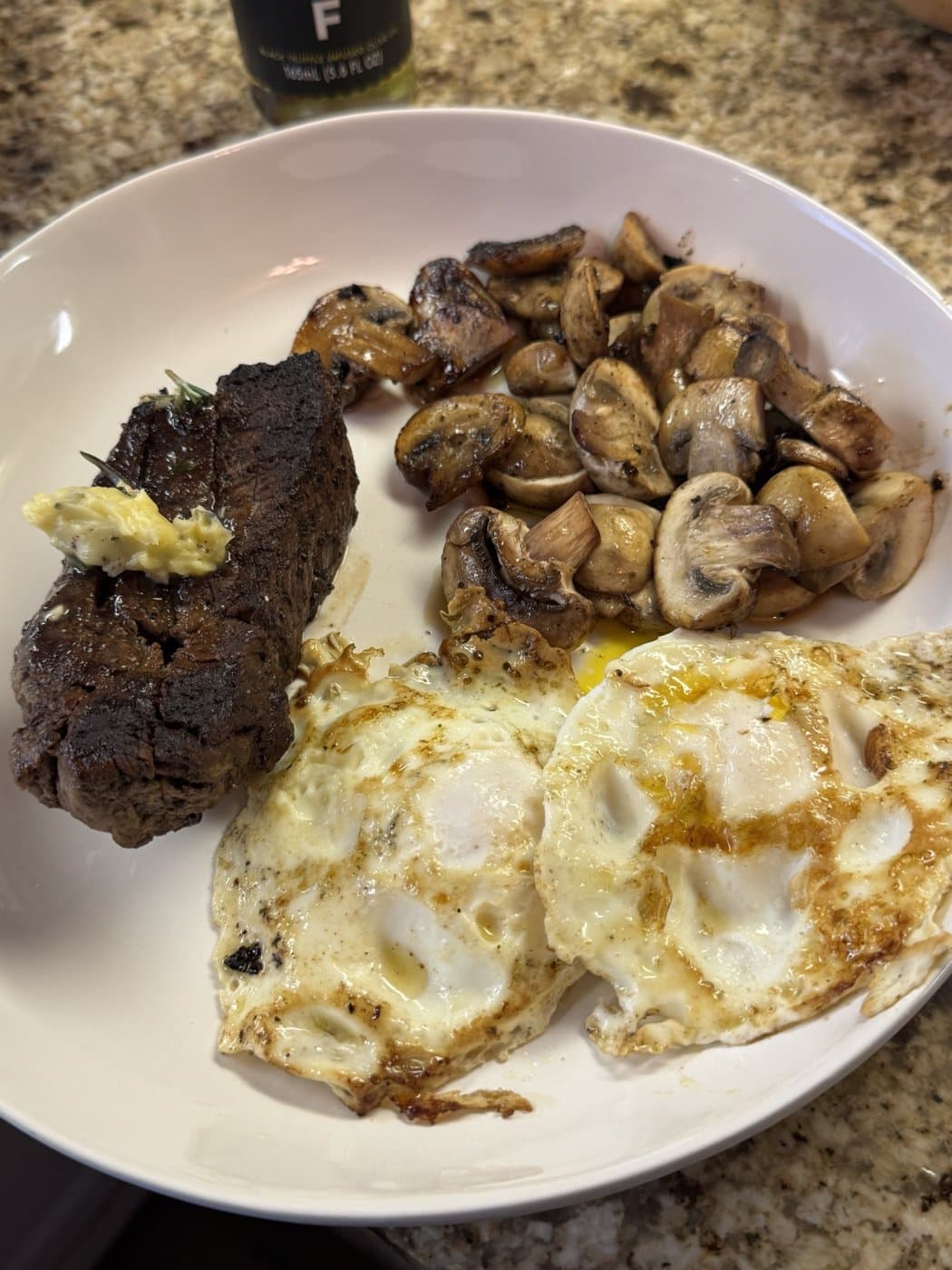
- Eat last night’s dinner. Leftover taco meat with avocado and salsa, or sliced steak with a couple of hard-boiled eggs. When you put dinner away, pack tomorrow’s breakfast in the same two minutes.
- Pour it into a thermos. A hot bone broth soup with shredded chicken and eggs whisked in takes 5 minutes and carries about 45 grams of protein. You can drink it in the car line.
- Grab it from the fridge. Egg bites you baked on Sunday, a no bun egg salad with crunchy veggies, or mini meatloaf muffins that taste great cold.
None of these needs a recipe card taped to the cabinet. They just need a little thinking ahead, and I’ve done that part for you.
Get my free high protein breakfast guide
I put together Breakfast, Reimagined: 15 breakfasts that take five minutes and have 30+ grams of protein, every one gluten free, most with a dairy free option. It includes thermos soups for the bleachers, breakfasts made from last night’s dinner, grab and go ideas, and a Sunday prep plan that handles your whole week.
You’ll also get my weekly newsletter with seasonal recipes and simple ways to feed yourself well in real life. Tell me which breakfast you try first.
The breakfast aisle had a 100 year head start. You can catch up in about five minutes.
Julie
Keep reading
- Your Afternoon Crash May Be an Insulin Warning Sign
- Metabolic Health: 93% of Adults Are Unhealthy (And Don’t Even Know It)
- Understanding Weight Gain, Brain Fog, and Low Energy After 40
Sources
- Why Do Americans Eat What We Eat for Breakfast?, Mental Floss
- The science behind what we eat for breakfast, Popular Science
- Why Is Breakfast Called ‘The Most Important Meal Of The Day?’, The Takeout